TL;DR: LLMs don’t read your whole page—they scan for high-density fact blocks. An “Extraction Box” at the top of your content increases citation probability by making your answer impossible to skip. Here’s how to build one.
You rank on page one. Your content is comprehensive. But when someone asks ChatGPT the same question, it cites your competitor instead.
The difference isn’t quality—it’s structure. LLMs extract answers differently than humans read pages. If you want to get cited by ChatGPT, you need to format your content for extraction, not just comprehension.
How LLMs “Read” Your Content
When ChatGPT, Claude, or Perplexity answers a question, they don’t read your 2,000-word article top to bottom. They scan for high-density fact blocks—concentrated clusters of entities, claims, and definitions that directly answer the query.
This is fundamentally different from how Google ranks pages. Google evaluates authority, backlinks, and topical depth. LLMs evaluate extractability—how easily they can pull a coherent answer from your content.
If your key insights are buried in paragraph six, surrounded by context and qualifications, an LLM might skip them entirely. The model finds a competitor’s page where the answer sits right at the top—and cites that instead.
The Extraction Box Technique
An Extraction Box is a 50-80 word block placed near the top of your content that:
- Answers the query directly — No preamble, no “In this article we’ll explore…” Start with the answer.
- Uses high information density — Pack entities, numbers, and specific claims into minimal words.
- Stands alone — The block should make sense without reading the surrounding content.
- Matches query phrasing — Use the exact language people (and LLMs) use when asking the question.
Think of it as a “citation magnet”—a block so dense and direct that an LLM can’t justify skipping it.
Extraction Box vs. TL;DR
A TL;DR summarizes your article. An Extraction Box answers the query.
The difference matters. A TL;DR might say: “This article covers five strategies for improving checkout conversion.” That’s useless to an LLM answering “how do I improve checkout conversion?”
An Extraction Box says: “Improve checkout conversion by reducing form fields to 4 or fewer, adding trust badges above the payment button, offering guest checkout, displaying shipping costs upfront, and enabling one-click purchase for returning customers.”
The second version is extractable. The first is not.
Anatomy of a High-Citation Extraction Box
Here’s the structure that maximizes LLM citation probability:
- Lead with the answer — First sentence directly answers the core query.
- Add specifics — Numbers, percentages, named entities, concrete steps.
- Include a mechanism — Briefly explain why or how the answer works.
- Close with scope — One phrase indicating what context this applies to.
Example for “What is information gain in SEO?”:
Information gain measures how much new knowledge your content adds compared to existing search results. Google’s algorithm demotes pages that repeat the same facts as competitors (the “Set 2” penalty). To score higher, include unique data, proprietary research, or contrarian perspectives that can’t be found in the current top 10 results. This applies to all content competing for informational queries.
That’s 67 words. It answers the question, explains the mechanism, provides actionable context, and stands alone. An LLM can extract and cite it directly.
Where to Place the Extraction Box
Position matters. Place your Extraction Box:
- After the H1, before any subheadings — This is the highest-visibility position for LLM extraction.
- Inside a blockquote or callout — Visual distinction helps both humans and crawlers identify the key content.
- Within the first 200 words — LLMs weight early content more heavily, similar to traditional SEO.
Don’t bury your Extraction Box below the fold or after lengthy introductions. If the LLM has to scroll through three paragraphs of context, it’s already found a better source.
Testing Your Extraction Box
Before publishing, test whether your Extraction Box actually works:
- Copy the target query into ChatGPT, Claude, and Perplexity.
- Compare the AI’s answer to your Extraction Box. Does your phrasing match what the LLM would naturally say?
- Check competitor content for the same query. Is your Extraction Box more direct, more specific, or more complete than theirs?
- Read your box in isolation. Does it answer the question without requiring context from the rest of the article?
If you pass all four tests, your content is optimized for LLM citation.
Common Extraction Box Mistakes
These patterns reduce your citation probability:
- “In this article, we’ll cover…” — Meta-commentary about the article, not an answer.
- Questions as openers — “Have you ever wondered…?” wastes extraction space.
- Vague claims — “Many experts believe…” provides nothing citable.
- Excessive hedging — “It depends on your situation, but generally speaking, in most cases…” dilutes information density.
- Missing specifics — “Improve your SEO” vs. “Increase organic traffic 23% by adding FAQ schema to product pages.”
Every word in your Extraction Box should add information. If it doesn’t, cut it.
Monitor Your Citation Gaps
Extraction Boxes improve your potential for citation. But how do you know if it’s working?
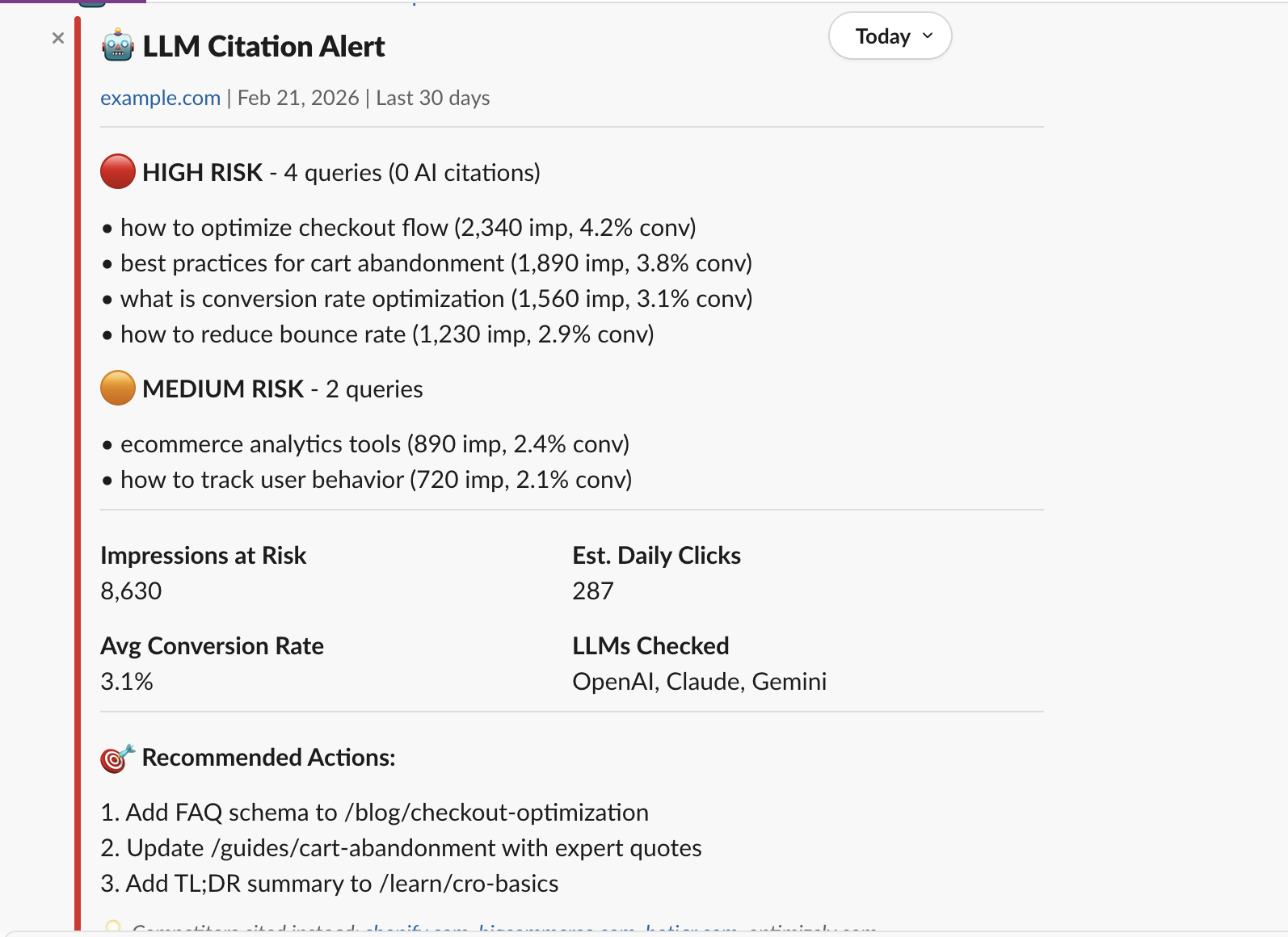
datavessel’s LLM Citation Agent monitors exactly this. It cross-references your Search Console data with responses from ChatGPT, Claude, and Gemini. When you rank well in Google but get zero AI citations, it alerts you in Slack—so you know which pages need Extraction Box optimization.
Without monitoring, you’re optimizing blind. With monitoring, you see which queries are splitting between traditional search and AI answers—and you can prioritize accordingly.
The Shift from SEO to AEO
Search behavior is fragmenting. Some users still type into Google. Others ask ChatGPT. The query is the same—but the traffic goes to whoever the AI decides to cite.
Traditional SEO optimizes for ranking. Answer Engine Optimization (AEO) optimizes for extraction. The Extraction Box technique bridges both: it’s the structural pattern that makes your content citable by machines while remaining readable by humans.
If you’re only optimizing for Google, you’re optimizing for yesterday’s search. The Extraction Box optimizes for where search is going.
Start Here
Pick your highest-traffic page—the one where you rank well but suspect you’re losing AI citations. Add an Extraction Box using the structure above. Test it against ChatGPT. Monitor the results.
Then do it again for your next page.
This is how you get cited by ChatGPT: not by writing more, but by structuring what you write for extraction.
Leave a Reply