TL;DR: The Content Delta Agent compares your content against top competitors, calculates your Information Density score, and generates a specific injection plan—exactly what to add, where to add it, and why it matters for both SEO and AEO. No more guessing what makes content “better.”
You published a comprehensive article. It ranks. But is it actually differentiated? Or are you just repeating what the top 3 results already say?
Google’s Information Gain algorithm demotes content that adds nothing new. LLMs skip pages that don’t offer extractable, unique insights. If your content lives in the “zero-gain zone,” you’re invisible to both.
The Content Delta Agent fixes this.
What the Content Delta Agent Does
The agent analyzes your page against top-ranking competitors and calculates your Information Density (ID) score—a composite metric that measures how much unique value your content provides.
It breaks down:
- Unique Entities (UE) — Concepts, frameworks, or tools you mention that competitors don’t
- Factual Claims per 100 words (FC) — How dense your content is with specific, quotable facts
- Original Insight percentage (OI) — What portion of your content is proprietary vs. generic
- Expert Citations (EC) — References to studies, data, or authorities that boost credibility
Then it tells you exactly what’s missing—and how to fix it.
The Knowledge Consensus Problem
Every search query has a “knowledge consensus”—the facts that appear in every top result. Repeating these facts doesn’t help you rank. It’s the zero-gain zone.
The agent identifies what’s consensus (keep it brief) versus what’s missing (your opportunity). Here’s what that looks like in practice:
| Consensus Point | Appears In | Action |
|---|---|---|
| SEO = ranking; AEO = AI citations | 3/3 competitors | Don’t lead with this |
| LLMs favor clear structure | 3/3 competitors | Keep it brief |
| Schema helps machines parse content | 2/3 competitors | Mention, don’t explain |
If you’re spending 500 words explaining what every competitor already explains, you’re diluting your Information Density score.
GIST Gap Analysis
The agent identifies five types of gaps that differentiate your content:
- Expert Nuance — Failure modes, edge cases, or implementation details competitors skip
- Recent Data — Fresh citations from 2025-2026 that prove you’re current
- First-Party Data — Your own experiments, case studies, or proprietary metrics
- Contrarian Perspective — A clear stance where you disagree with conventional wisdom
- Edge Cases — Guidance for specific scenarios (e-commerce, docs, multi-intent pages)
Each gap comes with impact rating (High/Medium/Low) and specific instructions on how to fill it.
Citation Hooks: Ready to Use
The agent generates 2-3 “Citation Hooks”—50-80 word blocks optimized for LLM extraction. These are the exact phrases an AI would quote when answering questions about your topic.
Each hook includes:
- Placement recommendation (after H1, in a specific section, etc.)
- The complete text, ready to copy-paste
- A “takeaway” line that reinforces memorability
You’re not guessing what LLMs want to cite. You’re engineering the citation.
Content Injection Plan
The final output is a prioritized action list:
Priority 1 — High Impact (Add this week):
- Add 2-3 authoritative citations + fresh 2025-2026 stats
- Add a mini case study or experiment table
- Add troubleshooting section for failure modes
Priority 2 — Medium Impact:
- Add templates for different page types (blog, docs, e-commerce)
- Clarify terminology distinctions (AEO vs GEO vs SEO)
Priority 3 — Nice to Have:
- Add visual diagram of the concept
- Add internal links to related content
Each item specifies the exact location in your content and why it matters for Information Density.
Example Report
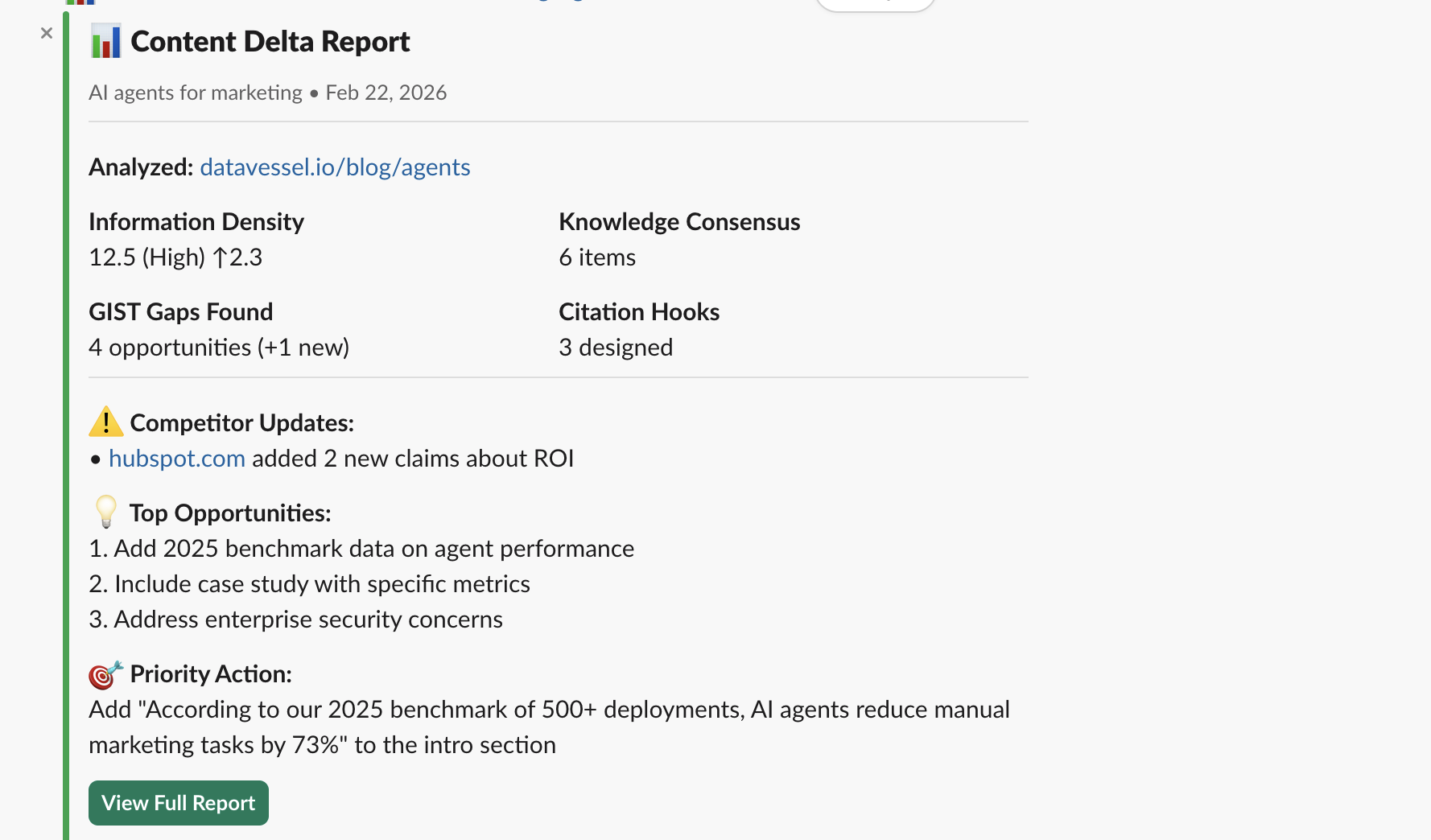
Here’s a real Content Delta Report the agent generated for one of our own posts:
Information Density Score: 13.7/20 (High)
Your article differentiates strongly on a concrete, structural tactic (the “Extraction Box”) and is already written in an LLM-extractable format. Biggest opportunity vs competitors: add more authoritative citations + 1-2 pieces of first-party evidence (even small experiments) to make it “reference-grade” for 2026 AEO content.
Competitors analyzed: 3 (DMI, AthenaHQ, Semrush)
The report then broke down:
- 2 Unique Entities — Extraction Box technique; datavessel LLM Citation Agent
- 0.6 Factual Claims per 100 words — 14 specific claims across 2,200 words
- 70% Original Insight — Most content is proprietary framework, not definitions
- 0 Expert Citations — No external studies (identified as biggest gap)
The agent also provided 3 ready-to-use Citation Hooks and a schema alignment plan (Article, Person, Organization, HowTo, FAQPage).
Why Information Density Matters in 2026
Google’s algorithm increasingly rewards content that adds to the knowledge graph—not content that restates it. The Information Gain patent explicitly describes demoting “Set 2” pages (yours) if they offer nothing new after “Set 1” (competitors).
LLMs have a similar bias. They extract from the most information-dense, most authoritative sources. If your content is generic, it gets skipped. If it’s dense with unique entities and specific claims, it becomes the citation.
The Content Delta Agent gives you the score and the fix—so you know exactly where you stand and what to do about it.
Deploy It Now
The Content Delta Agent is available in the datavessel agent library. Connect your site, point it at a URL, and get your first report.
Run it on your top 5 pages. See where you’re differentiated—and where you’re in the zero-gain zone.
Leave a Reply